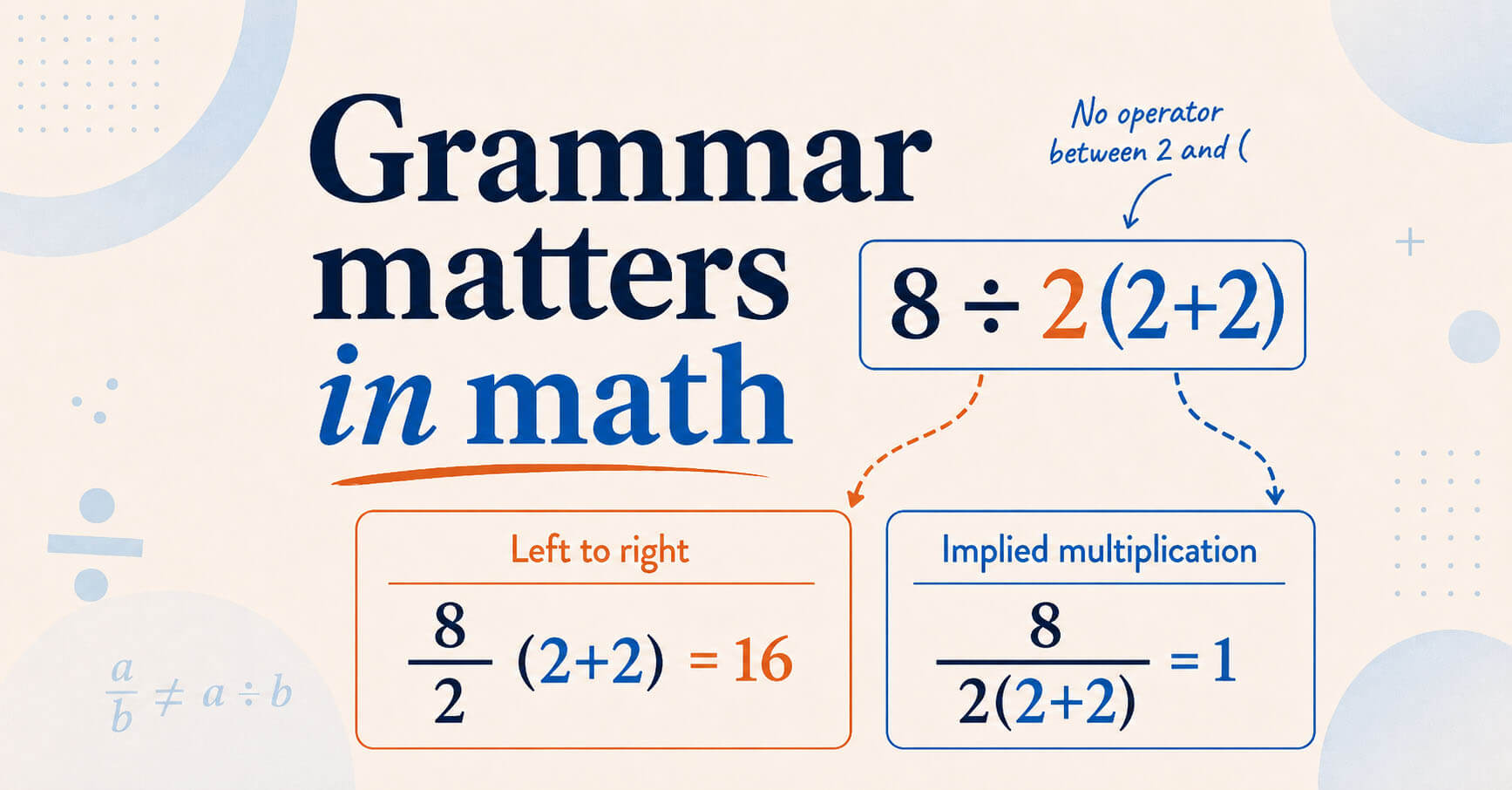
I had one of those small realizations recently that feels obvious only after you see it clearly:
Math is exact, but mathematical notation still has to be interpreted.
That sounds strange, because most of us are taught math as the opposite of interpretation. In school, math was the subject where there was supposed to be one right answer. Unlike English, history, or philosophy, math felt objective. You follow the steps, apply the rules, and arrive at the answer.
Then I saw this TikTok by @gravityassistus, and it made something click for me.
@gravityassistus The 100-Year-Old Typographic Trap You’ve seen this problem tearing comment sections apart: 8 ÷ 2(2+2). Half the world gets 16. The other half gets 1. Both sides will defend their answer to the death. But what if I told you the problem isn't your math—it's the typography. If you plug this equation into a modern Texas Instruments calculator, it spits out 16. If you plug it into a Casio, it spits out 1. Two machines built on pure logic, completely disagreeing on reality. How? It's called the Juxtaposition Paradox. If you got 16, you strictly followed modern PEMDAS rules. You solved the parentheses, and then moved left to right. It is cold, clinical, and algorithmically correct. But if you got 1, you executed a hidden, ancient mathematical protocol: Implied Multiplication by Juxtaposition. When a number is physically pressed against a parenthesis, your brain treats it as a single, bonded entity with higher priority than division. And you aren't crazy. If you look at the governing mathematical rules from 1917, multiplication by juxtaposition always took priority. One hundred years ago, the answer was undeniably 1. But over the decades, textbook publishers quietly erased that rule to make equations easier for early computers to parse. We traded human intuition for algorithmic efficiency. The true villain here is the "÷" symbol itself (the obelus). It is so inherently flawed and ambiguous that professional mathematicians simply refuse to use it, opting for a fraction bar instead. This isn't a math problem. It's a grammatical paradox designed to glitch your brain. So, what did your calculator say? And more importantly… what did your brain say?
♬ original sound – Gravity Assist
The video is about this expression:
8 ÷ 2(2+2)Depending on who you ask, the answer is either 16 or 1. And people do not just disagree casually. They argue like the other side is obviously wrong.
At first, that feels ridiculous. How can a simple arithmetic problem have two answers?
But the more I thought about it, the more I realized the problem is not the arithmetic. The problem is the notation.
The Problem Is Not the Numbers
The expression usually gets solved in one of two ways.
One person says:
8 ÷ 2(2+2)
8 ÷ 2(4)
8 ÷ 2 × 4
4 × 4
16
That follows the common school rule that multiplication and division have the same priority and should be evaluated from left to right.
Another person says:
8 ÷ 2(2+2)
8 ÷ 2(4)
8 ÷ 8
1
That person is reading 2(4) as one grouped factor. In algebra, when things are written side by side, like 2x, ab, or 2(2+2), they feel visually bound together. That is called juxtaposition or implied multiplication.
So which answer is correct?
The better answer may be: the expression is not written clearly enough.
The Missing Lesson: Before You Solve, You Have to Parse
In school, we were taught order of operations. Parentheses first. Exponents. Multiplication and division. Addition and subtraction. Depending on where you went to school, maybe you learned PEMDAS, BEDMAS, BODMAS, or something similar.
That system is useful, but it is also simplified.
We were often taught as if every expression is already written perfectly and all we have to do is apply the steps. But that skips something important:
Before you can solve the math, you have to understand what expression was actually written.
That is where notation matters.
The expression:
8 ÷ 2(2+2)is trying to compress something into one line that would be much clearer if written by hand as a fraction.
It could mean:
8 / (2(2+2)) = 1That is “8 divided by the entire quantity 2(2+2).”
Or it could mean:
(8 / 2) × (2+2) = 16That is “8 divided by 2, then multiplied by (2+2).”
Those are not the same expression. They only look similar because the original version used a flat, one-line division symbol instead of a fraction bar or clearer parentheses.
The Division Symbol Is Doing Too Much Work
This is where the ÷ symbol becomes part of the problem.
In early school math, ÷ is fine because the problems are simple:
8 ÷ 2No confusion there.
But once expressions become more algebraic, the division symbol becomes less precise than a fraction bar. A fraction bar does more than mean “divide.” It also groups the numerator and denominator.
For example, this is clear:
      8
------------
2(2 + 2)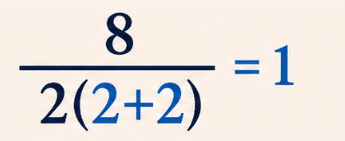
The entire 2(2+2) is in the denominator. The answer is 1.
This is also clear:
8
-  (2 + 2)
2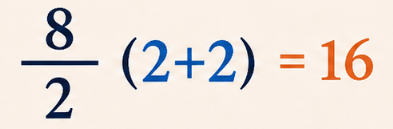
Here only the 8 is divided by 2, and then the result is multiplied by (2+2). The answer is 16.
When both are flattened into one line, the visual grouping disappears. That is why the original expression causes arguments.
We Were Taught Rules, But Not Always Grammar
This is the part that changed how I think about it.
I used to think math did not involve interpretation. But now I think that is only true after the notation has been made clear.
Math itself is exact. But math notation is a language. Like any language, it has grammar, conventions, and context.
In English, this sentence is ambiguous:
I saw the man with the telescope.
Did I use the telescope to see the man? Or did the man have the telescope?
The sentence is grammatically valid, but unclear. The issue is not that reality is subjective. The issue is that the sentence does not give enough structure.
The same thing is happening with:
8 ÷ 2(2+2)The math is not subjective. The notation is unclear.
Calculators Do Not Solve the Argument
One common response is, “Just put it into a calculator.”
But calculators are not interpreting meaning the way humans do. They follow parser rules. Different calculators, programming languages, and math software can parse implied multiplication differently.
Some treat:
8 ÷ 2(2+2)as:
(8 ÷ 2) × (2+2)Others may treat the implied multiplication as more tightly grouped:
8 ÷ (2(2+2))A calculator giving an answer does not prove the expression was well-written. It only tells you how that calculator chose to parse it.
That is an important distinction.
PEMDAS Did Not Exactly Fail Us, But It Was Incomplete
I do not think the lesson is that school taught us “wrong math.” The arithmetic rules we learned are useful.
But we were often taught them as if they were the whole story.
The missing part was math grammar.
We should have learned that parentheses are not only instructions for what to calculate first. They also show what belongs together. We should have learned that a fraction bar groups terms in a way that a ÷ symbol often does not. We should have learned that implied multiplication can visually bind terms together, especially in algebra.
Most importantly, we should have learned that badly written expressions can be ambiguous.
That would have made problems like this less of a trick and more of a lesson in clear communication.
The Better Way to Write It
So instead of asking people to fight over:
8 ÷ 2(2+2)we should ask what was actually meant.
If the intended answer is 1, write:
8 / (2(2+2)) = 1If the intended answer is 16, write:
(8 / 2) × (2+2) = 16Both are clear. Both are valid. They are just different expressions.
The original problem is not a great test of intelligence. It is a test of how people parse unclear notation.
The Revelation
The real revelation for me is this:
Math is precise, but writing math clearly is still a form of communication.
When the communication is unclear, people can apply reasonable rules and still arrive at different answers. Not because math has become subjective, but because the notation did not fully specify the structure.
That is a much more interesting lesson than “PEMDAS says I am right.”
It means that even in math, grammar matters.